

For a long time, Python was not associated with true parallel thread execution. The main reason was the Global Interpreter Lock, or GIL. In CPython, it prevented multiple threads from executing Python bytecode at the same time.
In practice, this had two consequences. First, thread safety in Python often received less attention than in other programming languages because the GIL appeared to provide a certain level of protection. Second, Python was frequently not considered for use cases that require lightweight, true multithreading.
Free-threaded Python changes this starting point. The free-threaded build was introduced experimentally with Python 3.13. With Python 3.14, its experimental status was removed. One thing is clear: Python without the GIL is here to stay.
As a result, Python is becoming more relevant not only for workloads that can be parallelized, but also for the question of how safely Python code behaves under true parallel execution.
For development teams, this is more than a technical detail. When multiple threads access shared data at the same time, bugs can arise that are difficult to reproduce and even harder to debug. Coordination between threads therefore becomes significantly more important, bringing thread safety into sharper focus in modern Python software architectures.
Threads are more lightweight than processes because they share memory and the same interpreter. They are therefore particularly useful when tasks are closely related but can still be processed concurrently.
Typical use cases for parallel execution include:
As a general rule, the established asyncio library is well suited to I/O-bound workloads such as network access, file operations, or server-side request handling when only one CPU core is required.
Free threading becomes the more appropriate choice when tasks should run simultaneously across multiple CPU cores, for example in data processing, image processing, or mathematical calculations, or when cooperative waiting based on await conditions is not desirable.
As soon as multiple threads modify shared objects, clear protection mechanisms become essential.
Thread safety means that a program continues to behave correctly even when multiple threads run at the same time and access shared data or resources.
The key principle is:
Shared mutable objects and non-atomic operations must be reviewed carefully.
One of the main risks is a race condition. A race condition occurs when the result of a program depends on the order in which threads are executed. Operations that appear simple are particularly vulnerable because they may consist of several internal steps.
A basic example is incrementing a counter. Although this may look like an atomic operation, Python performs several steps internally: reading the current value, modifying it, and writing the result back.
If several threads access and modify the same counter at the same time, the outcome may become unpredictable. Some updates may be applied while others are lost, depending on which thread executes which step at which moment.
Thread safety is achieved through synchronization mechanisms. These mechanisms serve several purposes:
The following sections introduce the most important tools from Python’s threading and queue libraries.
A threading.Lock ensures that a section of code can only be executed by one thread at a time. This is particularly important when multiple threads modify the same state, such as a counter or an object.
Some operations on lists, dictionaries, or sets are atomic. It is therefore worth checking the documentation for the specific operation being used. When in doubt, however, it is generally safer to protect the operation than to take unnecessary risks.
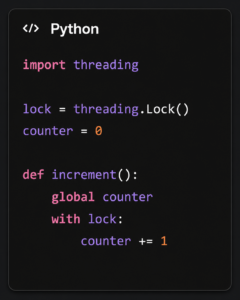
Locks can be managed manually using acquire() and release(). However, using a lock as a context manager with with is recommended because the lock is then released automatically.
A threading.RLock, or reentrant lock, can be acquired multiple times by the same thread. This is useful when nested functions need to use the same lock.
An RLock must be released as many times as it has been acquired. RLocks are particularly relevant in recursive or nested execution paths, although they introduce slightly more overhead than standard locks.
queue.Queue is a thread-safe implementation for ordered message passing. It is useful when threads need to exchange tasks, events, or data.
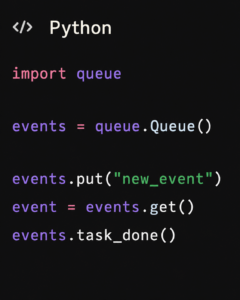
Instead of protecting shared lists with custom locks, threads can communicate through queues. This significantly reduces complexity and the risk of synchronization errors.
This approach is particularly useful in the following scenarios:
Thread safety is not limited to protecting data. Threads often also need to be coordinated, for example in multi-stage pipelines or producer-consumer scenarios.
The threading library provides several synchronization primitives for this purpose.
A threading.Event acts as a simple signal between threads. It can be used for start signals, shutdown procedures, or pause-and-resume mechanisms.
A threading.Barrier ensures that multiple threads reach a shared synchronization point before any of them continue.
A threading.Condition is useful when threads need to wait for a specific state or condition to become true.
A threading.Semaphore limits the number of simultaneous accesses to a resource, such as database connections, file handles, or other restricted resources.
While locks protect individual objects and provide data synchronization, these mechanisms help maintain the integrity of the overall runtime state. In other words, they provide execution synchronization.
They are typically created in the main thread and passed to worker threads.
Organizations that use Python strategically should review existing codebases specifically for thread-safety risks.
Important questions include:
Thread safety should not be treated as a corrective measure after bugs occur. It should be considered an integral part of clean software architecture from the outset.
AI-generated code is not automatically thread-safe.
Developers remain responsible for reviewing the correctness, safety, and synchronization behavior of AI-generated solutions.
With free-threaded Python introduced in version 3.13 and stabilized in Python 3.14, multithreading is becoming significantly more important.
The central principle remains the same:
Identify shared mutable state deliberately, protect critical sections, and coordinate threads carefully.
The threading library provides a range of established tools for this purpose. One useful practical detail is that Python’s logging library is thread-safe by default.
From the perspective of modern software development, reliable code should not only work under ideal conditions. It must also remain stable under load, during parallel execution, and in real-world production environments.
At the same time, free threading makes Python more attractive for new areas of application. Development teams should not hesitate to explore and actively use these new possibilities.