

CIOs today face a particular challenge: technological diversity has never been greater, while at the same time there is growing pressure to deliver faster, more efficiently, and in compliance with regulations. Cloud platforms, modern analytics stacks, AI use cases, and increasing regulatory requirements are colliding with historically grown IT landscapes.
The right technology partner is not only a good fit for the company in technical terms, but also in organizational, strategic, and regulatory terms. Successful CIOs therefore evaluate partners primarily not on product features, but on use case fit, integration capability, governance maturity, and implementation expertise.
In our analytics and cloud projects, we see time and again that technology decisions fail less because of functionality and more because of a lack of fit with the existing organization and architecture.
In this environment, choosing a technology partner is no longer a purely technical decision. It is a strategic decision that has long-term implications for costs, innovation, and operational stability. Wrong decisions not only lead to budget overruns or project delays, but often also to dependencies on individual providers, which can only be corrected later at great expense.
At the same time, practice shows that it is not technology alone that determines success, but the interaction between the platform, partner ecosystem, and implementation expertise. CIOs therefore need less marketing promises and, above all, clear decision-making logic.
Before evaluating technologies or partners, CIOs should answer a fundamental question: What specific goal is the company pursuing with the investment?
In practice, these goals can usually be classified into several categories:
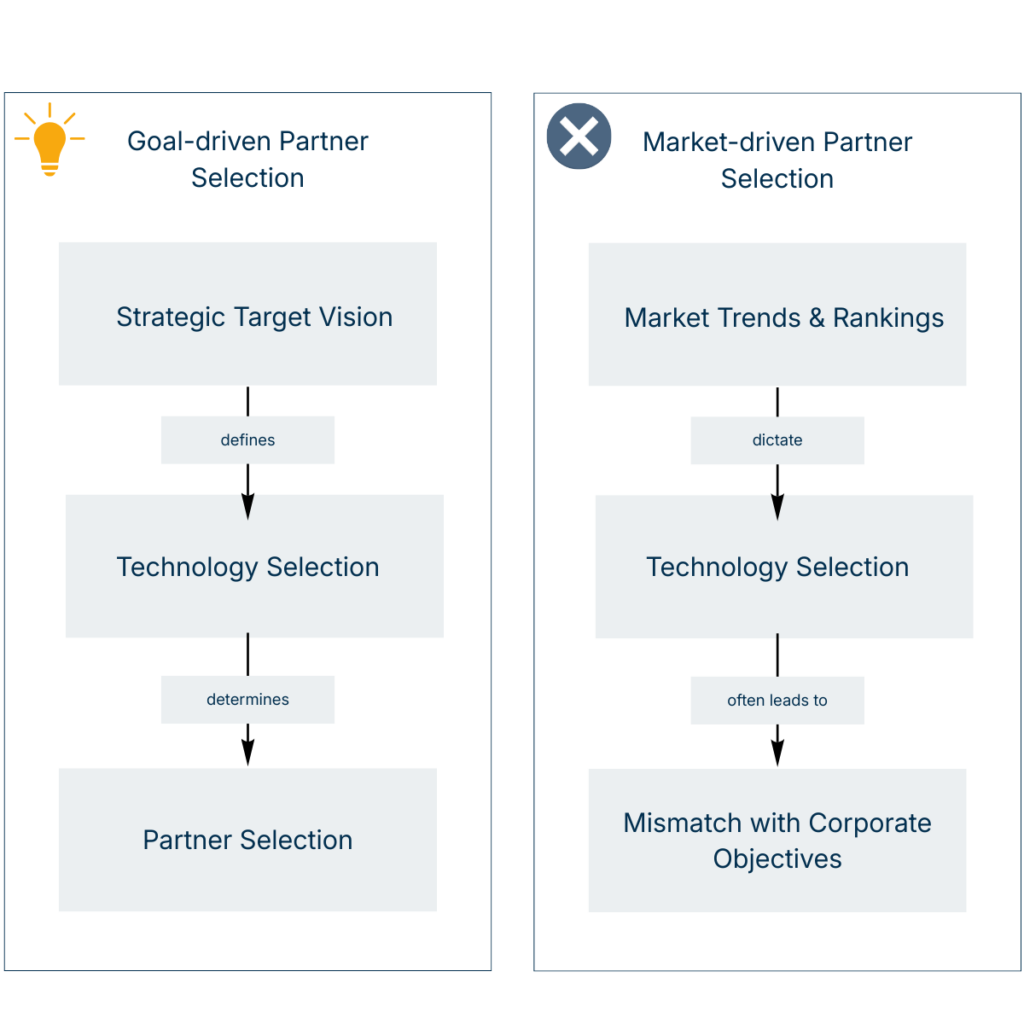
Goal-driven partner selection leads from strategic goals to the right technology and partner choice. Market-driven selection often creates a mismatch with business objectives.
A common mistake in practice is to base technology decisions primarily on market trends or manufacturer rankings. Successful CIOs reverse this logic: first comes the target vision, then the selection of technology and partners.
Once the strategic goals have been defined, the next step is to conduct a structured evaluation of potential technology partners. In practice, successful decisions are rarely based on individual factors. Rather, it is the overall assessment of technology, ecosystem, and implementation expertise that determines long-term success.
The following ten criteria have proven to be particularly relevant in enterprise environments:
These ten criteria help CIOs make technology and partner decisions in a systematic, comparable, and strategically sound manner. They form the basis for a robust shortlist – and prevent decisions from being made solely on the basis of market trends or manufacturer promises.
Of course, there are other criteria that can play an important role depending on the business context. These include contractual framework conditions, commercial flexibility, support and SLA models, regional availability, cultural fit between the organizations involved, or specific requirements of individual departments. These additional aspects are relevant for operational collaboration.
However, they do not replace a strategic assessment. In practice, they should only be considered once a reliable shortlist has been drawn up based on the key criteria. This is because strategic criteria determine whether a partnership is viable. Operational criteria merely influence how it is structured.
While individual providers try to cover as many requirements as possible, partner ecosystems aim to combine specialized technologies in a targeted manner.
The days of monolithic IT landscapes are over. Modern data and analytics architectures consist of a variety of specialized components: cloud infrastructure, data platforms, integration tools, BI tools, data science environments, and operational systems. No single manufacturer covers all these requirements in equal depth.
In our experience, modern data architectures work particularly well when they are not tailored to a single manufacturer, but are deliberately built as a partner ecosystem. However, this type of architecture requires an integration partner who is equally proficient in multiple platforms – both technically and organizationally.
A best-of-breed approach makes it possible to use the right technology for different requirements and combine them in a meaningful way. At the same time, however, the technical and organizational complexity increases.
It is therefore not only crucial which technologies are selected, but also how well they interact and how clearly responsibilities are defined. A strong partner ecosystem ensures:
A phase-based approach has proven effective for making technology and partner decisions that are transparent and reliable. It creates transparency, reduces risks, and facilitates internal coordination, especially in complex enterprise environments.
At the outset, the data strategy, target architecture, governance requirements, budget framework, and time dependencies are clearly defined. This shared target vision serves as a reference framework for all technology and partner decisions as the process progresses.
Suitable platforms and partners are identified based on the defined criteria. In practice, two to four options have proven to be useful for establishing comparability without unnecessarily complicating the decision-making process.
Pilot projects should pursue concrete, measurable goals – such as costs, performance, time-to-value, or operational complexity. The decisive factor is the real added value in the corporate context, not technical feasibility alone.
In addition to technological aspects, the focus here is on delivery capability, project experience, transparency, and long-term cooperation. The decision should always take into account the operational and further development phases.
In complex partner ecosystems, one aspect is becoming increasingly important: neutrality. CIOs benefit from partners who are not primarily tied to the sale of a specific technology, but who focus on the long-term benefits for the company.
As a technology-agnostic consulting and implementation partner, HMS helps companies make informed technology decisions—regardless of whether the optimal path leads through AWS, Microsoft Azure, Snowflake, Databricks, SAS, or other platforms.
The focus is not on recommending individual products, but on objectively evaluating target architectures, integration scenarios, governance requirements, and long-term operability. Especially when it comes to strategic initiatives such as platform modernization, cloud migration, or building analytics and AI capabilities, this neutral perspective is often crucial for the long-term success of a project.
Selecting the right technology partner is much more than a procurement process. It is a strategic management decision that has long-term implications for costs, innovation capabilities, and operational stability.
CIOs who base their decisions on clearly defined goals, transparent criteria, and a structured approach lay the foundation for sustainable success. Technology, partner ecosystem, and implementation expertise must always be considered together.
In an increasingly complex IT world, it is not the individual platform that is the decisive success factor, but the ability to deploy the right partners at the right time in the right combination.