

A customer escalation often starts with a simple message: “This invoice is wrong. Please check it.”
In an enterprise environment, that request may involve customer service, billing, contract review, ERP data, case management and human approval. A single prototype assistant might try to handle everything directly. A production architecture usually cannot.
The Agent2Agent Protocol, or A2A, becomes relevant when independent AI agents need a standard way to discover each other, delegate work, exchange context, track task progress and return reliable results. It standardizes the collaboration layer between agents, while APIs, workflow engines and the Model Context Protocol, MCP, remain important for business functions, data access and tool integration.
The official A2A specification describes A2A as an open standard for communication and interoperability between independent AI agent systems. Its goals include agent discovery, modality negotiation, collaborative task management and secure information exchange without access to another agent’s internal state, memory or tools. The latest released specification is version 1.0.0.[1]
This article helps enterprise teams decide when A2A is the right collaboration layer, when MCP or APIs are sufficient, and which governance questions must be answered before adoption.
The Agent2Agent Protocol enables independent AI agents to communicate and collaborate across systems, teams and platforms.
A2A defines a shared interaction model. Instead of custom point-to-point integrations, agents expose capabilities through a standard contract. Other agents can discover those capabilities, send messages, create tasks, receive status updates and collect final results.
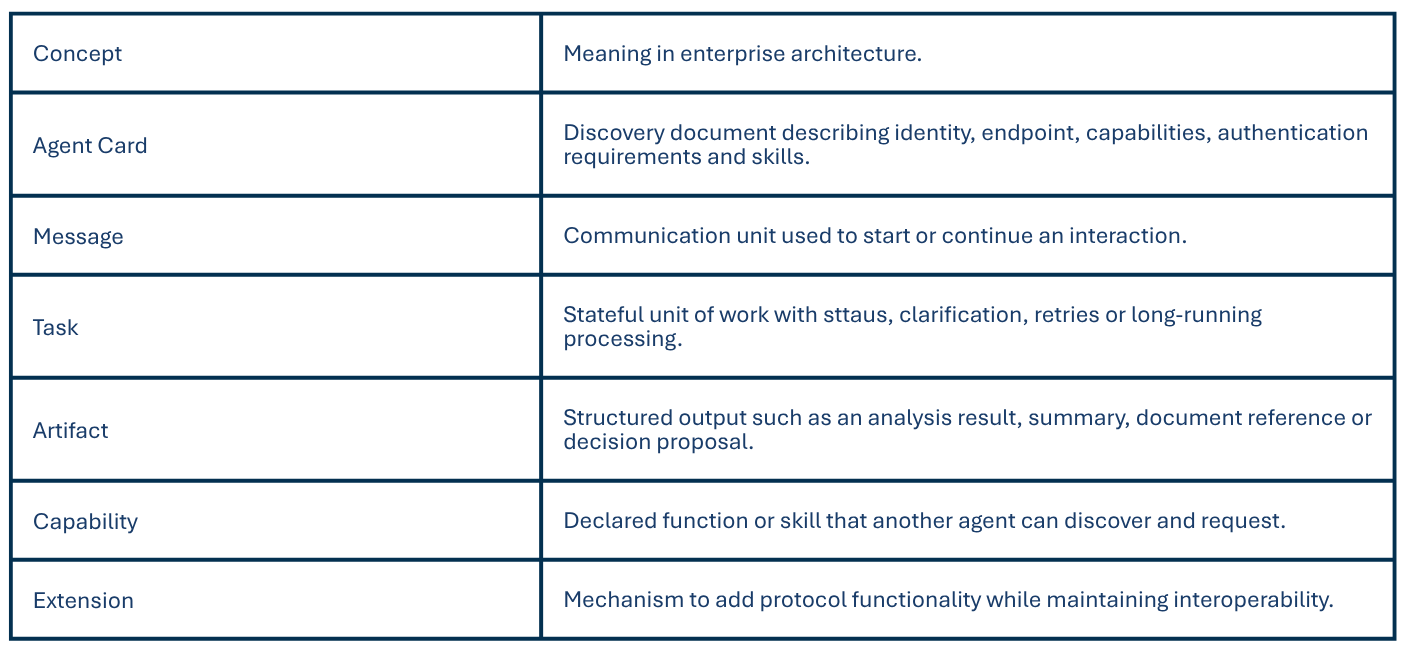
A2A does not define how an agent reasons internally. It does not prescribe prompts, memory architecture, LLM choice, planning logic, vector databases or business APIs. That separation lets teams expose agent capabilities without exposing their implementation.
A useful rule is: use A2A as the external collaboration contract, not as the internal architecture model of an agent.
A2A matters because many organizations are moving from isolated AI assistants to landscapes of specialized agents. Without a shared interaction model, those landscapes become difficult to integrate, monitor and govern.
Most enterprise AI initiatives start with a contained use case: a support assistant, document analysis agent or internal knowledge assistant. Over time, organizations add specialist agents for billing, contract review, compliance, finance, IT operations or data analysis. These agents may be built by different teams, based on different frameworks, hosted in different environments or supplied by different vendors.
The challenge is coordination. Agents need a common way to answer practical questions: What can this agent do? Who owns it? Which authentication method is required? Which artifacts are returned? How are errors, timeouts and approvals handled?
Once agents become part of business processes, interoperability becomes an architecture and governance concern.
A2A, MCP and APIs are complementary. APIs expose business functions and data, MCP connects agents to tools and context, and A2A coordinates collaboration between agents.
The Model Context Protocol is an open-source standard for connecting AI applications to external systems such as data sources, tools and workflows.[4] A2A addresses a different layer: communication and coordination between agents. The A2A v1.0 announcement describes A2A and MCP as complementary.[2]
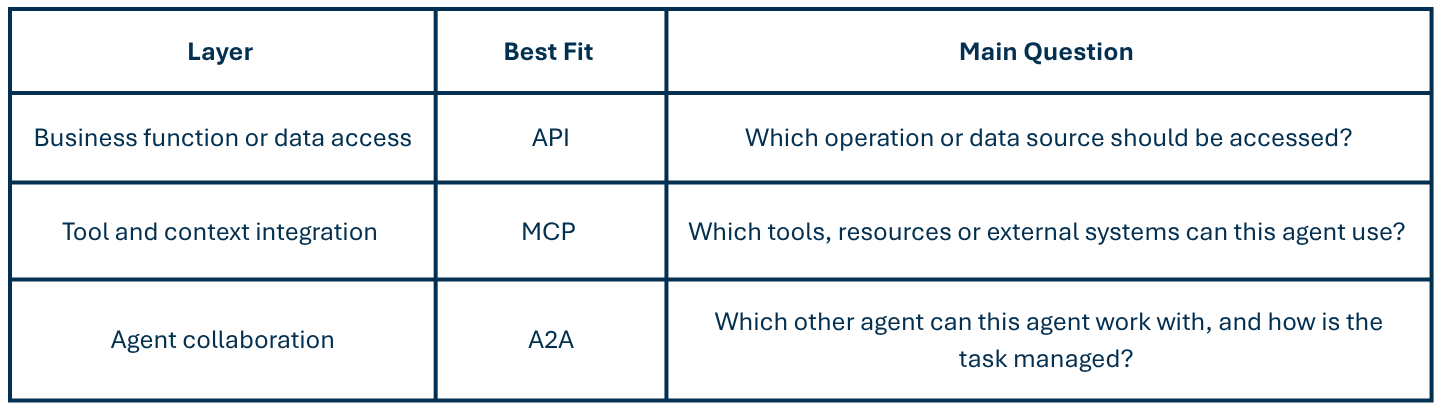
Decision rule: APIs expose what a system can do, MCP extends what an agent can use, and A2A extends whom an agent can work with.
For example, a customer service agent may use A2A to delegate an invoice clarification to a billing agent. The billing agent may internally use MCP or APIs to query ERP data and invoice documents. The customer service agent only needs a reliable way to request the work, track progress and receive the result.
Use A2A when the remote capability behaves like an agent: it can interpret a request, manage a task, ask clarifying questions or produce artifacts. For simple database queries, deterministic functions or short tool calls, MCP or a direct API is usually simpler.
Enterprises should evaluate A2A when several independent agents need to collaborate across ownership, platform, vendor or security boundaries. In simple terms: A2A is useful when the collaboration itself becomes part of the architecture problem.
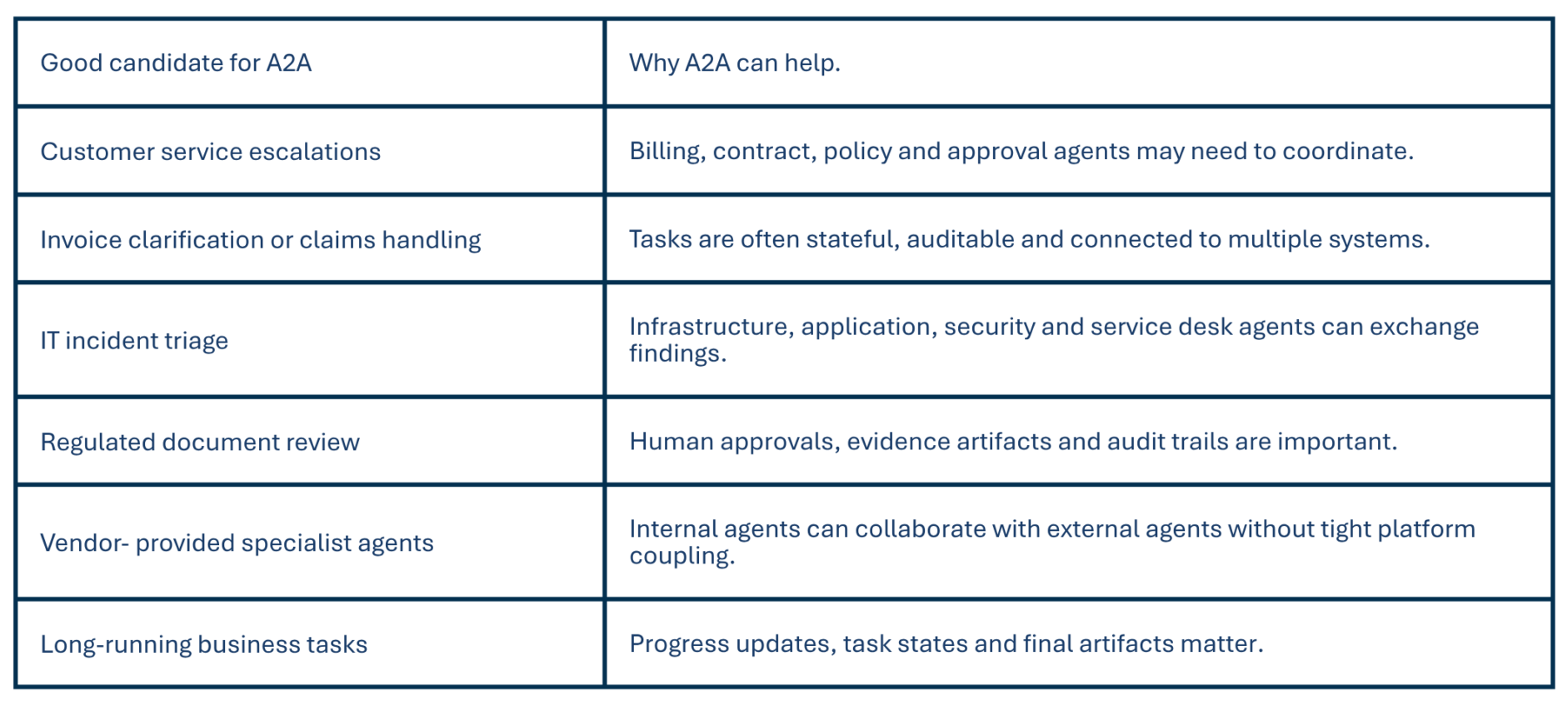
A2A is usually unnecessary when one assistant can handle the full process, one deterministic function solves the problem, the agent only needs tool access, or the workflow is fully controlled inside one application. In those cases, a single-agent design, MCP tool call, direct API or existing workflow engine may be the better fit.
Start with one meaningful multi-agent process. Customer-service escalation is a strong candidate because it combines business value, specialized responsibilities, existing systems and audit requirements.
A2A is especially useful for tasks that require delegation, progress tracking, intermediate evidence and final artifacts. Consider a B2B customer-service escalation: “Invoice 4711 contains a service fee we did not agree to. Please check the contract and correct the invoice.”
A possible A2A task flow could look like this:
A2A should sit in the agent collaboration layer, between user-facing assistants and the tool, data and workflow layer.
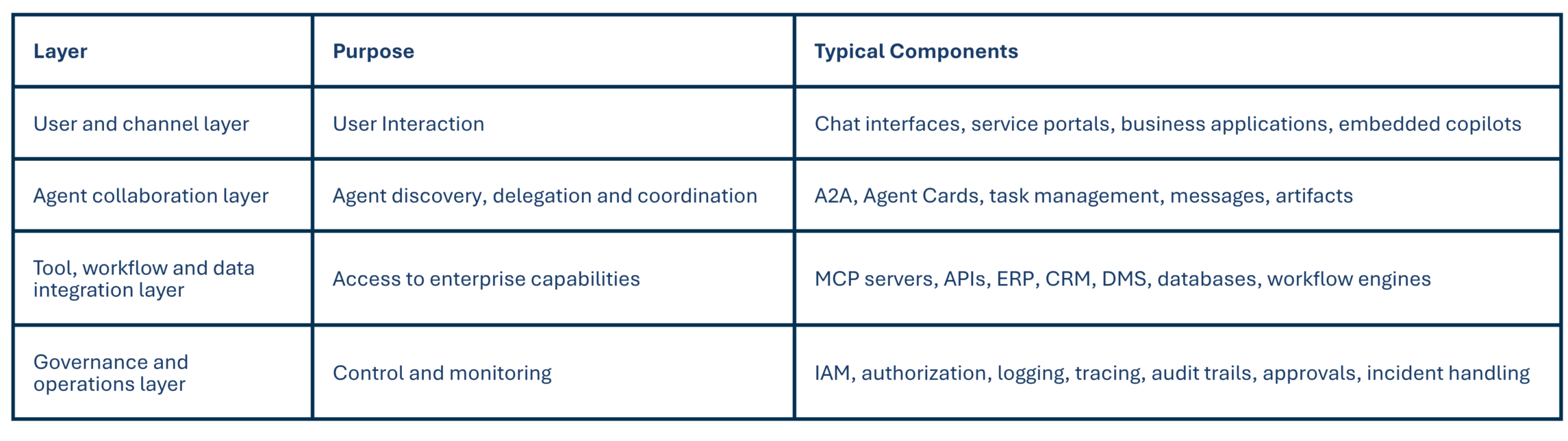
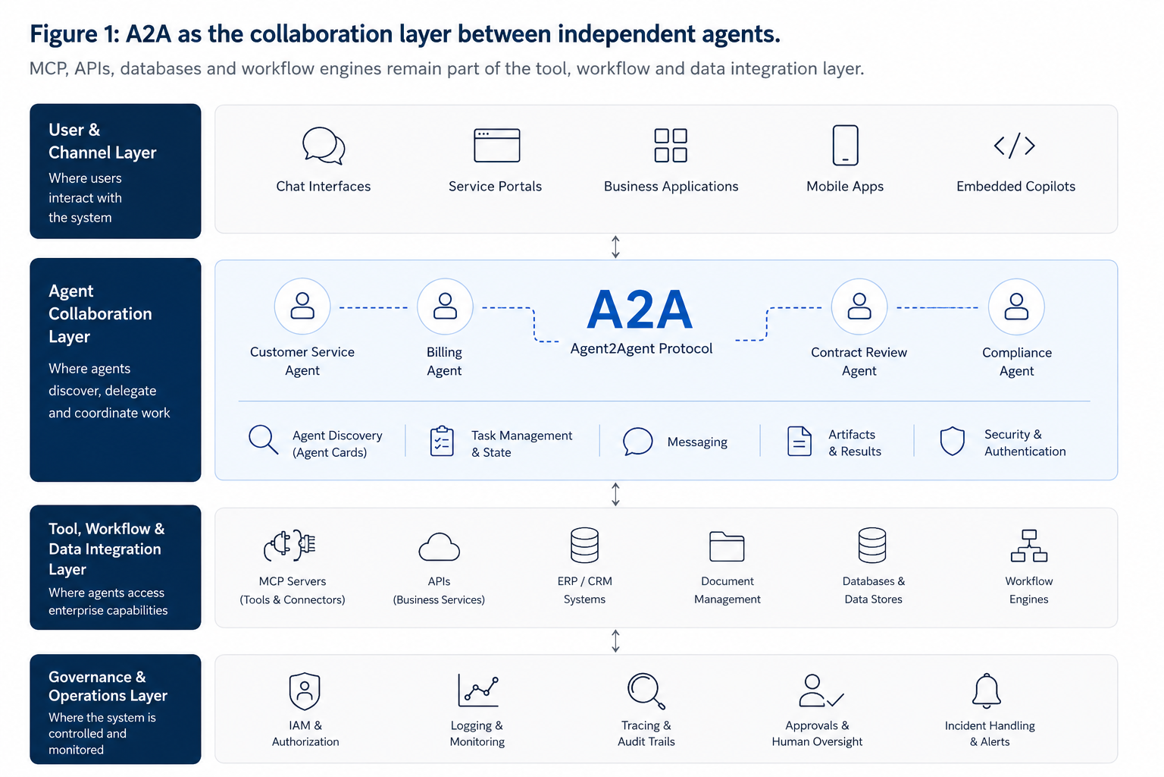
Figure 1: A2A as the collaboration layer between independent agents. MCP, APIs, databases and workflow engines remain part of the tool, workflow and data integration layer.
A2A should not blur architecture boundaries. An agent may expose its capability through A2A, use MCP to access tools, call APIs for business data and rely on enterprise monitoring for observability.
For HMS clients, this distinction matters because many AI initiatives start from a promising prototype and then need to become maintainable production systems. The better architecture question is: Can we operate, secure, monitor and evolve this agent landscape over time?
A2A standardizes communication, but enterprise teams still need clear rules for ownership, access control, logging, approvals and incident handling. The A2A specification describes enterprise-oriented principles such as authentication, authorization, security, privacy, tracing, monitoring, asynchronous tasks and opaque execution.[1] Opaque execution allows agents to collaborate without sharing internal thoughts, plans or tool implementations.
Before publishing agents for A2A collaboration, companies should answer these questions:
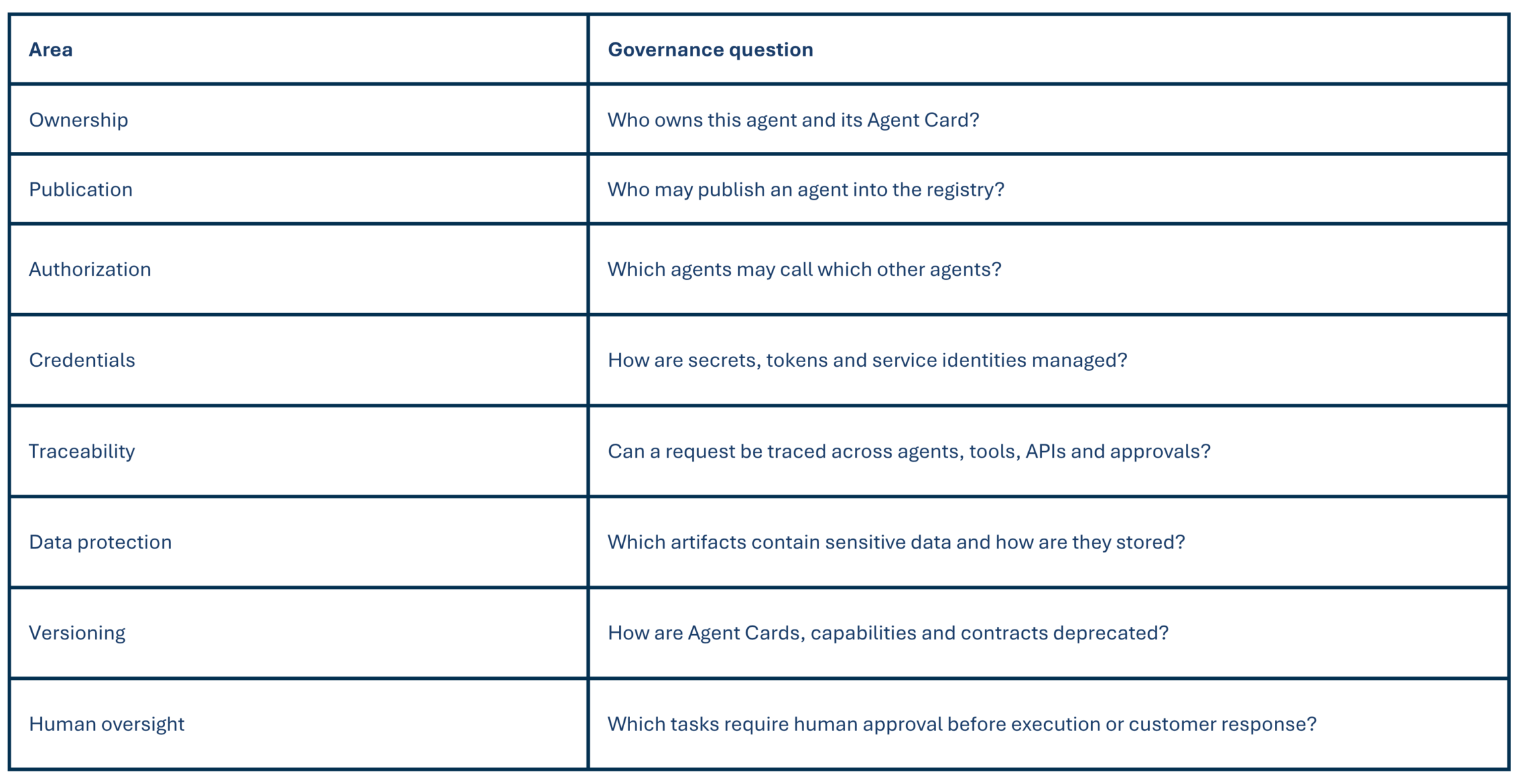
Observability is especially important. Once agents delegate work to other agents, debugging becomes distributed. Every A2A agent should therefore be treated as a production service: owned, versioned, monitored, access-controlled and auditable.
The biggest A2A risk is not the protocol itself. The bigger risk is creating an uncontrolled agent landscape without clear ownership, task semantics and observability. Build a small reference setup before standardizing broadly. A customer service agent, billing agent and contract agent are enough to validate Agent Card quality, authentication, logging, task handling, artifact formats and failure behavior.
A2A is mature enough to evaluate seriously for enterprise multi-agent architectures, but it should still be adopted based on concrete coordination needs.
The official specification lists version 1.0.0 as the latest released version.[1] The v1.0 announcement describes it as the first stable, production-ready version and highlights enterprise capabilities such as multi-protocol bindings, version negotiation, multi-tenancy and signed Agent Cards.[2]
The Linux Foundation reported in April 2026 that A2A had grown to more than 150 supporting organizations, including AWS, Google, IBM, Microsoft, Salesforce, SAP and ServiceNow.[3]
For enterprise teams, this means A2A is mature enough to be part of architecture discussions where independent agents need a shared, governable way to collaborate. The right question is not: “Should we use A2A because it is new?” The better question is: “Do we have independent agents that need to collaborate across teams, platforms, vendors or security boundaries?”
HMS can help companies evaluate where A2A creates real value, design the collaboration layer and build secure reference implementations for production environments. A2A adoption should not start with the protocol. It should start with the business process and the architecture problem. Typical first questions are:
This is where HMS’s software engineering, data engineering and AI implementation experience becomes relevant. A2A creates value only when embedded in a reliable enterprise architecture, including integration design, security, observability, testing, deployment and long-term maintainability. For many organizations, the best first step is a focused architecture assessment or reference implementation: identify one high-value multi-agent process and prove it can run securely, transparently and operably.
A2A helps enterprises move from isolated AI assistants to governable multi-agent collaboration. Its value lies in standardizing discovery, delegation, task state, progress updates and artifacts between independent agents. Organizations often notice the need for A2A when a successful agent prototype grows into a landscape of specialized agents. At that point, custom integrations become a bottleneck and production monitoring becomes harder. The practical recommendation is clear: start with one real multi-agent process. Define the agents, tasks, artifacts, ownership, access rules and monitoring requirements. Then decide whether A2A is the right collaboration contract. Planning a multi-agent architecture or evaluating how A2A and MCP fit into your enterprise AI roadmap? Book an A2A architecture assessment with HMS. HMS can help identify a suitable pilot process, separate A2A, MCP and API responsibilities, and design a secure reference implementation for production.
[1] Official Agent2Agent Protocol specification: latest released version, core concepts, task model and enterprise principles.
[2] A2A Protocol v1.0 announcement: production-ready release, enterprise requirements and relationship to MCP.
[3] Linux Foundation A2A adoption announcement: ecosystem scale, supporting organizations and cloud-platform adoption.
[4] Official Model Context Protocol introduction: MCP as a standard for connecting AI applications to tools, data sources and workflows.